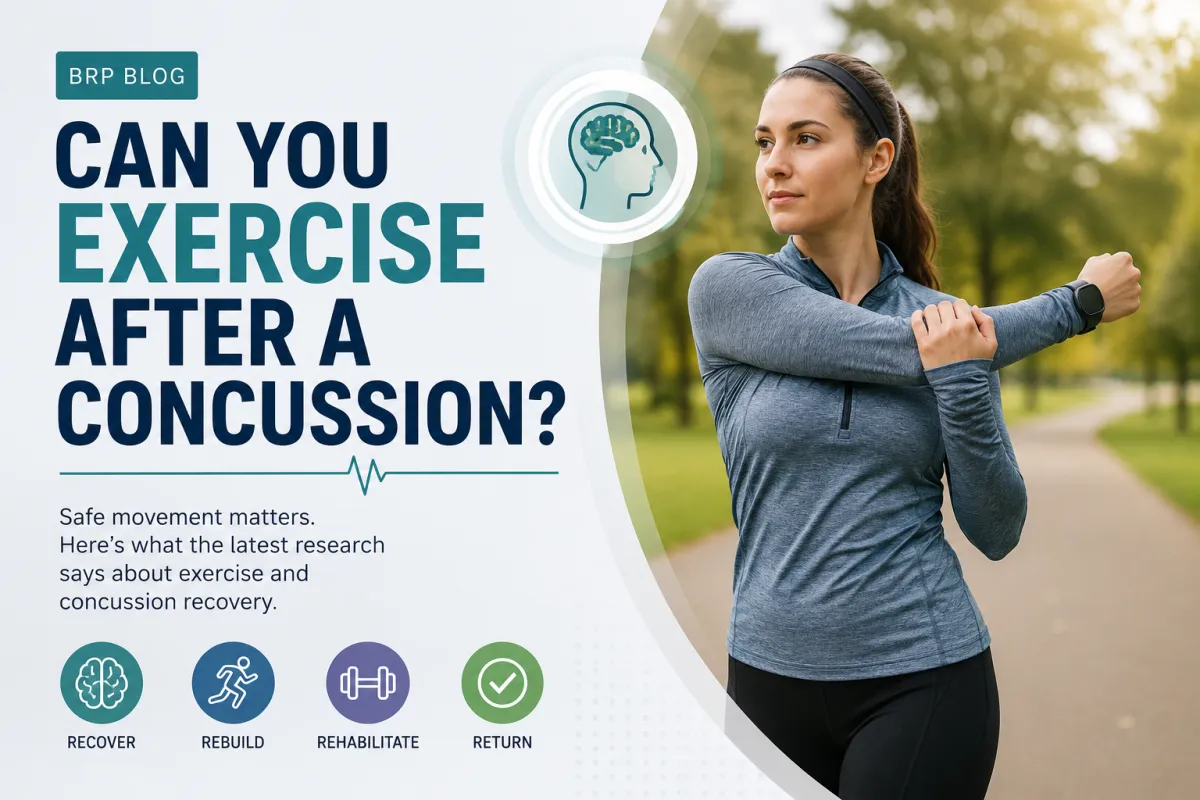
Can You Exercise After a Concussion?
If you have had a concussion, one of the most common questions is:
“Can I exercise if I still have symptoms?”
This is a very normal question.
For many years, people were told to rest in a dark room until every symptom went away. That advice created a lot of fear around movement, activity, and exercise.
But we now know that complete rest for too long is usually not the best path forward. For many people, after the first 24 to 48 hours, gentle movement and light aerobic exercise can actually support recovery.
That does not mean jumping back into hard workouts.
It does not mean pushing through severe symptoms.
And it does not mean ignoring your body.
It means learning how to move in a smart, gradual, symptom-guided way.
Why Exercise Can Feel Hard After a Concussion
After a concussion, your brain and nervous system can become more sensitive.
Your body may also have trouble regulating blood flow, heart rate, and activity tolerance the same way it did before the injury. Because of this, things that used to feel easy may suddenly feel harder.
You may feel okay sitting still, but then symptoms increase when you:
Walk farther than usual
Climb stairs
Go to school
Return to work
Run errands
Try to exercise
Spend time in busy environments
Common symptoms that may increase with activity include headache, dizziness, brain fog, fatigue, nausea, light sensitivity, or feeling overwhelmed.
This does not automatically mean you are damaging your brain.
Often, it means your current activity level is a little more than your system can tolerate right now.
That is an important distinction.
The goal is not to avoid all symptoms forever. The goal is to find the right starting point and gradually build from there.
What Should You Do in the First 24 to 48 Hours?
In the first day or two after a concussion, it is usually best to take things easy.
This does not mean strict bed rest.
You can still get up, eat meals, move around the house, take care of basic daily activities, and do light activity as tolerated.
But formal exercise is usually not the main priority during the first 24 to 48 hours.
During this early period, your brain and body need a little time to settle. Try to reduce major physical, cognitive, visual, and emotional stressors. Keep things simple and manageable.
A helpful mindset is:
Rest does not mean doing nothing. It means doing less than usual while staying gently active when tolerated.
When Can You Start Light Exercise?
After the first 24 to 48 hours, many people can begin light aerobic exercise if their symptoms allow.
This may include:
Walking
Stationary biking
Easy treadmill walking
Gentle movement around the house
Light outdoor walking in a calm environment
The goal is not to get a hard workout.
The goal is to gently raise your heart rate while keeping symptoms controlled.
A simple rule is:
You should be able to comfortably carry on a conversation while exercising.
If you are breathing so hard that you cannot talk comfortably, you are probably exercising too intensely for this stage of recovery.
For many people, a reasonable starting point is around 20 minutes of light aerobic activity per day. However, some people may need less at first. Others may tolerate a little more.
The right amount depends on your symptoms, your activity tolerance, your health history, and where you are in recovery.
Is It Okay If Symptoms Increase During Exercise?
This is one of the most important things to understand.
A small symptom increase during exercise can be okay.
For many people, a mild increase of about 1 to 2 points on a 10-point symptom scale is acceptable.
For example, if your headache is a 2 out of 10 before walking and it increases to a 3 or 4 out of 10 during the walk, that may be okay as long as it stays controlled.
But there are some important limits.
You should slow down, reduce intensity, or stop if:
Symptoms increase more than 1 to 2 points
Symptoms keep climbing
Symptoms feel hard to control
You feel unsafe, faint, or severely dizzy
Symptoms do not settle after exercise
A helpful recovery rule is:
Symptoms should return to your pre-exercise level within about one hour.
If they do not, that usually means you did too much, too soon.
That does not mean you failed. It simply gives you information.
Next time, you may need to reduce the time, intensity, environment, or type of exercise.
Avoid the Two Extremes
One of the biggest mistakes after concussion is going to one extreme.
Some people avoid all activity because they are afraid of symptoms.
Others push too hard because they are frustrated and want to get back to normal.
Both responses are understandable.
But the better path is usually somewhere in the middle.
You want to move, but not overload your system.
You want to challenge your brain and body, but not push through severe symptoms.
You want to build confidence, but not ignore warning signs.
A simple framework is:
Move daily. Start light. Watch your symptoms. Progress gradually.
Why Light Aerobic Exercise May Help Recovery
Light aerobic exercise can support concussion recovery in several ways.
It may help your body gradually improve tolerance to heart rate changes and activity. It may also support better blood flow regulation, reduce fatigue, improve sleep, and help your brain adapt after injury.
This process is not about forcing recovery.
It is about giving your brain and body the right amount of input at the right time.
Think of it like turning a dial instead of flipping a switch.
Too little activity may keep your system deconditioned and sensitive.
Too much activity may flare symptoms.
The goal is to find the “just right” level that your system can handle today, then build from there.
Practical Recovery Tips
1. Start with walking or stationary biking
Choose something simple and controlled. Walking and stationary biking are often good starting points because they allow you to control speed, time, and intensity.
2. Use the talk test
You should be able to talk comfortably while exercising. If you cannot, slow down.
3. Track your symptoms
Before exercise, rate your symptoms from 0 to 10.
During exercise, notice whether symptoms stay stable, increase slightly, or climb quickly.
After exercise, check how long it takes symptoms to settle.
4. Keep the environment simple
Early in recovery, a quiet walk in a calm area may be easier than walking through a busy store, crowded gym, or noisy school hallway.
The environment matters.
5. Progress one thing at a time
Do not increase time, speed, intensity, and environment all at once.
Start with one variable.
For example, you might first increase walking from 10 minutes to 15 minutes before increasing speed or adding hills.
6. Get help if symptoms keep flaring
If you are not sure how much exercise is safe, or your symptoms keep increasing with activity, it may be helpful to work with a healthcare professional trained in concussion rehabilitation.
A structured exertion test can help identify your current exercise tolerance and guide a more specific plan.
FAQ: Exercise After Concussion
Can I exercise if I still have concussion symptoms?
In many cases, yes. After the first 24 to 48 hours, light aerobic exercise may be helpful if symptoms stay controlled. The key is to start gently and avoid pushing through significant symptom increases.
What type of exercise should I start with?
Light aerobic activity is usually a good starting point. This may include walking, stationary biking, or swimming.
How hard should I exercise?
Keep the intensity low enough that you can comfortably carry on a conversation. If you are breathing too hard to talk, you are likely going too hard.
Is it bad if my symptoms increase during exercise?
A mild increase may be okay, especially if it is only 1 to 2 points on a 10-point symptom scale. However, symptoms should settle back to baseline within about an hour. If they do not, you likely did too much.
Should I rest until all symptoms are gone?
Usually, no. After the first day or two, too much rest can sometimes slow recovery. Most people do better with a gradual return to activity that is guided by symptoms.
When should I get professional help?
You should consider getting help if exercise consistently causes symptom flares, if you are unsure where to start, if symptoms are not improving, or if you feel unsafe with activity.
Key Takeaways
Complete rest for too long is usually not the best recovery strategy.
Take it easier during the first 24 to 48 hours after concussion.
After that, light aerobic exercise may support recovery if symptoms allow.
Walking, stationary biking, and easy treadmill walking are common starting points.
A small symptom increase may be okay, but symptoms should settle within about an hour.
Avoid both extremes: doing nothing and pushing too hard.
A healthcare professional can help create a more personalized exercise plan.
Conclusion: Recovery Is About the Right Amount
Concussion recovery is not about doing nothing.
It is about doing the right amount, at the right time, for your brain and body.
Light aerobic exercise can be a powerful part of recovery when it is introduced gradually and guided by symptoms.
If you are not sure where to start, download my free Light Aerobic Exercise After Concussion handout here. It gives you a simple, symptom-guided way to begin moving again without guessing or pushing too hard too soon.
And if you want a full step-by-step recovery plan, the Brain Recovery Project Concussion Recovery Course walks you through education, guided self-assessment, and a personalized plan you can follow from home. Learn more about the course here.
