Could Your Neck Be Causing Dizziness After a Concussion?
Dizziness after a concussion can be confusing. You may feel off balance when you walk, lightheaded while working at a computer, or unsteady when you turn your head. It is natural to assume every dizzy sensation is coming directly from the brain or inner ear. Sometimes, however, the neck is also part of the problem.
A concussion and a neck injury can happen during the same event. The force that moves the head and brain can also strain the joints, muscles, and other tissues of the cervical spine. When the neck is painful, stiff, or not sensing movement accurately, it may contribute to dizziness and imbalance.
Key point: Neck-related dizziness is one possible contributor, not a diagnosis you can confirm from one symptom or one self-test. A comprehensive evaluation is the best way to identify which systems are involved.
Why Can the Neck Affect Dizziness and Balance?
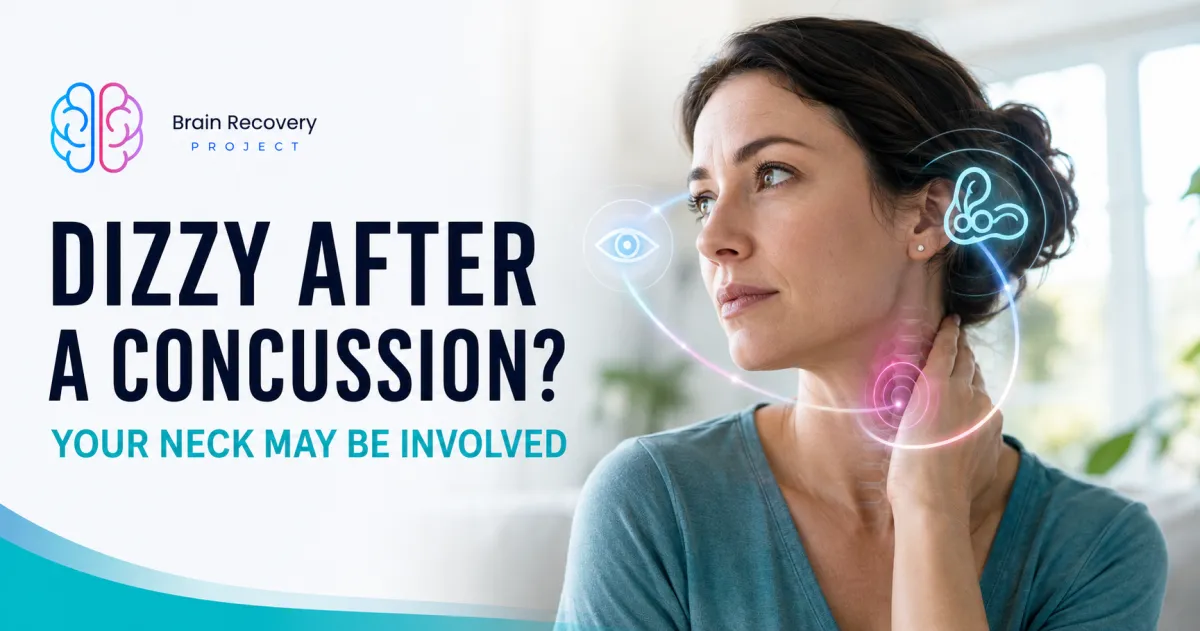
Your neck does more than support your head. Small sensors in the muscles and joints continually send information to the brain about where your head is positioned in relation to your body.
Your brain compares that information with signals from your eyes and the balance organs in your inner ears. When the signals agree, you can keep your vision stable, maintain balance, and understand where you are in space. When the information does not match, you may feel disoriented, unsteady, or dizzy.
The upper part of the neck, near the base of the skull, plays an important role in this position-sensing system. After a concussion or whiplash-type injury, pain, limited movement, muscle tension, or reduced movement accuracy can change the quality of the information coming from the neck.
This does not mean the upper neck is always the cause. It means the cervical spine should be considered as one part of a larger balance system.
What Can Neck-Related Dizziness Feel Like?
People do not always use the word dizziness in the same way. Neck-related symptoms are often described as unsteadiness, floating, lightheadedness, disorientation, or a sense that the environment is moving. True spinning can occur, but spinning—especially during specific position changes—also raises concern for an inner-ear condition such as benign paroxysmal positional vertigo, or BPPV.
Patterns that may make a clinician look more closely at the neck include:
·Dizziness that occurs with neck pain, stiffness, or headache
·Symptoms that build during sustained posture, computer work, or driving
·Dizziness or imbalance with head turning
·Limited or painful neck motion
·Symptoms that change when the position or movement of the neck changes
These clues can support a cervical contribution, but none of them proves that the neck is the only source.
Why a Complete Evaluation Matters
Dizziness after concussion can come from several systems, and more than one system may be involved at the same time. For example, a person may have both BPPV and a painful neck. Another person may have visual motion sensitivity plus reduced neck position sense.
Different symptom patterns can point toward different contributors:
·Brief spinning when rolling in bed, lying back, or looking up may suggest BPPV.
·Symptoms in grocery stores, crowds, or while scrolling may involve visual motion sensitivity.
·Lightheadedness with standing or exercise may involve heart-rate or blood-pressure regulation.
·Episodes with light or sound sensitivity, motion sensitivity, or migraine history may fit a migraine pattern.
·Dizziness with neck pain, stiffness, limited motion, or sustained posture may increase suspicion that the neck is contributing.
There is no single scan or special test that definitively confirms cervicogenic dizziness. A trained clinician looks for a consistent pattern while also screening for other explanations.
What Might a Cervicogenic Dizziness Evaluation Include?
A clinician who understands both concussion and vestibular rehabilitation may assess several areas rather than examining the neck in isolation. The evaluation may include:
·The quality, timing, duration, and triggers of your dizziness
·Neck motion, pain, stiffness, mobility, and muscle function
·Your ability to sense and reproduce head position
·Balance and walking with head movement
·Eye movements and visual motion sensitivity
·Vestibular function and positional testing for BPPV
·Exercise tolerance and other neurological findings when appropriate
Some head-neck differentiation tests are designed to help a clinician compare movement coming from the neck with movement involving the head and inner ear. These are clinician-performed tests; you do not need to reproduce them on your own.
Practical Recovery Tips
1.Track the pattern. Describe whether the symptom feels like spinning, floating, lightheadedness, disorientation, or imbalance. Note the trigger, how long it lasts, and whether neck pain or headache changes at the same time.
2.Ask for a multisystem evaluation. Look for a clinician who can consider cervical, vestibular, visual, exertional, migraine-related, and neurological contributors rather than assuming all dizziness has one cause.
3.Use an individualized treatment plan. If the neck is contributing, treatment may address comfortable motion, neck muscle endurance, position sense, balance, and eye-head coordination. Hands-on care may also be used when appropriate.
4.Adjust exercises that repeatedly create strong symptoms. A mild and temporary increase in symptom awareness can occur during rehabilitation, but substantial or long-lasting dizziness should prompt a review of the exercise technique and dosage.
5.Keep rebuilding normal activity. Follow the activity plan recommended by your healthcare team. Recovery usually comes from gradually improving how the involved systems work together—not from finding one magical stretch.
Common Mistakes to Avoid
·Assuming every dizzy symptom after concussion has the same cause
·Focusing only on the eyes or inner ear while ignoring a painful or stiff neck
·Assuming the neck must be responsible for every episode of dizziness
·Forcing a neck stretch that causes substantial dizziness
·Repeatedly cracking or manipulating your own neck to chase short-term relief
The goal is not to blame one body part. The goal is to identify the combination of factors that best explains your symptoms and then match treatment to those findings.
When to Seek Urgent Medical Care
After a recent head or neck injury, seek urgent medical care for severe or worsening headache or neck pain, repeated vomiting, increasing confusion, fainting, seizure, new weakness or numbness, slurred speech, double vision, or worsening difficulty walking.
Frequently Asked Questions
Can a concussion cause cervicogenic dizziness?
A concussion does not automatically cause cervicogenic dizziness, but the same force can injure both the brain and the neck. Cervical pain, stiffness, altered muscle function, or reduced position sense may then contribute to dizziness.
How do I know whether my dizziness is coming from my neck?
Neck pain, stiffness, limited motion, sustained posture, and symptoms that change with head-on-trunk movement can raise suspicion. Because these symptoms overlap with inner-ear, visual, migraine, and exercise-related problems, a comprehensive clinical evaluation is needed.
Can cervicogenic dizziness occur without severe neck pain?
Yes. Some people report stiffness, fatigue, limited motion, headache, or symptoms related to posture rather than severe pain. The overall pattern matters more than the intensity of one symptom.
Should I stop vestibular exercises if my neck hurts?
Do not make a major change without discussing it with your clinician. The position, speed, range, duration, or visual demand of an exercise can often be adjusted while the cervical contribution is addressed.
How long does neck-related dizziness take to improve?
Recovery time varies because the contributing impairments and other concussion-related symptoms differ from person to person. A specific evaluation and a plan that is adjusted based on your response are more useful than a fixed timeline.
Key Takeaways
·The neck can contribute to dizziness after concussion, especially when neck pain, stiffness, headache, posture, or head movement changes the symptoms.
·Cervicogenic dizziness is identified from a pattern of findings and reasonable exclusion of other causes—not from one test.
·Vestibular, visual, migraine-related, exertional, and cervical problems can coexist.
·Treatment should be matched to the specific impairments identified during the evaluation.
·Persistent dizziness does not mean you are permanently stuck; it may mean another contributor still needs to be identified.
Conclusion
If your dizziness has lasted longer than expected, the next step may not be more of the same. A careful evaluation can turn the broad label of post-concussion dizziness into a more specific recovery plan.
If dizziness occurs with neck pain, stiffness, headache, head movement, or sustained posture, ask whether a cervical assessment should be part of your care. Understanding what is driving the symptoms can make recovery feel much more manageable.
Download the free Brain Recovery Project Post-Concussion Symptom Checklist to organize your symptoms and prepare for a more productive conversation with your healthcare provider. For a complete step-by-step recovery framework, explore the Brain Recovery Project Concussion Recovery Course. [Insert links before publishing]
Educational note: This article provides general education and is not a diagnosis or a substitute for individualized medical care.
