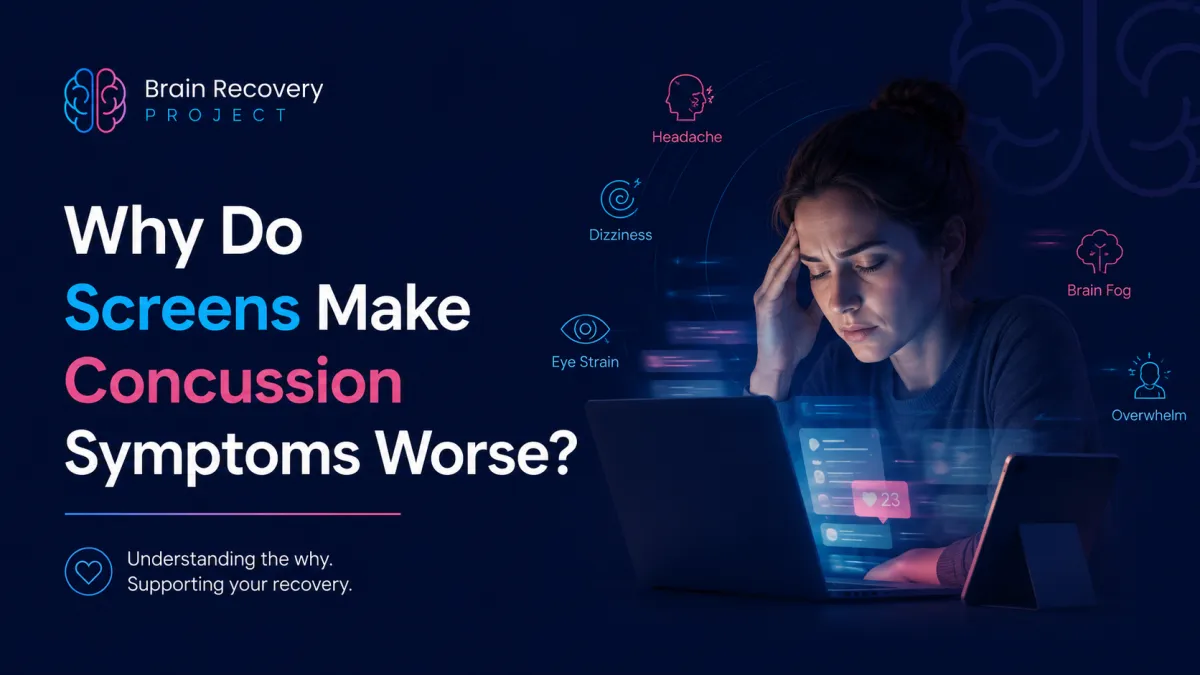
Why Do Screens Make Concussion Symptoms Worse?
Have you ever tried to use your phone, computer, or watch TV after a concussion and noticed your symptoms suddenly increase? Maybe your headache gets worse. Maybe your eyes feel tired. Maybe you feel dizzy, foggy, nauseous, or overwhelmed. When this happens, one of the first worries people have is:
“Did I just make my concussion worse?”
The good news is that, in most cases, a temporary increase in symptoms does not mean you damaged your brain again. It usually means your brain and body were pushed past their current tolerance level. After a concussion, screens can be challenging because they place multiple demands on your system at the same time. Understanding why this happens can help you feel less afraid and more confident as you return to normal activities.
Why Screens Can Trigger Symptoms After Concussion
Screens may seem like a simple activity, but they require a lot from your brain, eyes, and body.
When you use a phone, computer, tablet, or TV, your system may need to process:
Bright light
Visual motion
Scrolling
Reading
Eye movement
Focus and attention
Noise or sound
Fast-changing information
After a concussion, your brain may have a harder time processing this input efficiently. This does not mean your brain is permanently damaged. It means your system may be more sensitive and may need a gradual recovery plan. Sometimes it is not the screen itself that causes the problem. It may be the brightness. It may be scrolling. It may be reading. It may be eye strain. It may be that your brain is already tired, and screen use is simply the activity that pushes you over your limit.
Symptoms Are Information, Not Always Danger
One of the most important ideas in concussion recovery is this:
Symptoms are information. They are not always danger.
This is a big mindset shift. After concussion, it is easy to become afraid of anything that increases symptoms. But a mild, temporary increase in symptoms does not always mean you are causing harm. Instead, symptoms can help you understand your current tolerance level. A small increase in symptoms that settles back down relatively quickly is very different from a major symptom spike that lasts for hours or carries into the next day. So rather than only asking, “Did my symptoms increase?” it is more helpful to ask:
“How much did they increase, and how long did it take to recover?”
That recovery window gives you important information about what your system can currently handle.
Why Symptoms May Be Worse Later in the Day
Many people notice that screen symptoms are worse in the afternoon or evening.
This often happens because symptoms are not only based on one single activity. They can be based on the total load of the day.
For example, your brain may already be working hard from:
Checking your phone
Driving
Going to work or school
Talking with people
Processing noise and light
Reading emails
Making decisions
Managing stress
Moving through busy environments
By the time you sit down to watch TV or scroll on your phone, your system may already be close to its limit.
The screen may not be the only reason symptoms increased. It may simply be the final activity that pushed your brain and body beyond what they could tolerate in that moment.
Should You Avoid Screens After Concussion?
In the first 24 to 48 hours after a concussion, it is usually reasonable to reduce screen exposure, especially if screens clearly worsen symptoms. This early period is a time to let your system calm down. But after that early window, complete avoidance is usually not the goal. This surprises many people. If screens increase symptoms, it seems logical to avoid them completely. But if you avoid screens, reading, light, motion, sound, and activity for too long, your tolerance can actually become smaller. Your brain needs gradual, safe exposure to rebuild its ability to process the world around you. The key is not complete avoidance. The key is dosage.
How Much Symptom Increase Is Too Much?
A helpful rule of thumb is to pay attention to both the size of the symptom increase and how long it takes to recover.
A mild increase, such as 1 to 2 points out of 10, that settles back down within about an hour is usually very different from a major symptom spike that lasts for several hours or carries into the next day.
For example, if you use your phone for 10 minutes and your headache increases slightly but returns to baseline after a short break, that may be useful information. Your system may tolerate short periods of screen use.
But if 30 minutes of scrolling causes a major headache, dizziness, nausea, or fogginess that lasts the rest of the day, that tells you the dose was probably too high.
The goal is to find the level your brain can handle now, then gradually build from there.
Practical Recovery Tips for Screen Sensitivity
1. Reduce Screen Use During the First 24 to 48 Hours
Right after a concussion, give your system a chance to settle. You do not necessarily need to sit in a dark room all day, but limiting heavy screen use early on can be helpful. This may mean reducing long periods of phone use, computer work, video games, or TV if they clearly increase symptoms.
2. Start Small When You Return to Screens
When you start using screens again, begin with short blocks of time. For example, try 5 to 10 minutes, then take a break and see how your symptoms respond. If your symptoms stay manageable and return to baseline quickly, you may be able to gradually increase the time.
3. Adjust the Screen
Small changes can make a big difference.
Try:
Lowering brightness
Increasing font size
Reducing scrolling
Using audio instead of reading when possible
Taking breaks before symptoms get high
Avoiding phone use in a dark room
Using natural lighting when possible
Sitting farther away from larger screens
The goal is to make the screen easier for your brain and eyes to process.
4. Watch the Symptom Pattern
Different symptoms may point to different recovery needs. If screens mostly cause eye strain, frontal headache, blurry vision, or difficulty focusing, there may be a visual or oculomotor component. If screens trigger dizziness, nausea, or motion sensitivity, there may be a vestibular component. If brightness or light sensitivity is the main issue, your autonomic nervous system may be involved. This matters because the best recovery strategy may be different depending on what is driving the symptoms.
5. Look at the Whole Day, Not Just the Screen
If symptoms worsen with screens, also look at what happened before screen use.
Were you already tired?
Did you have a busy workday?
Were you in a noisy environment?
Did you skip meals or hydration?
Did you sleep poorly?
Sometimes screens are not the only problem. They may be one part of your total daily load.
FAQ: Screen Time After Concussion
Can screens make my concussion worse?
In most cases, a temporary symptom increase from screens does not mean you damaged your brain again. It usually means your system was pushed past its current tolerance level.
How long should I avoid screens after a concussion?
It is usually helpful to reduce screen exposure during the first 24 to 48 hours, especially if screens clearly increase symptoms. After that, the goal is usually gradual return, not complete avoidance.
Why do screens make me dizzy after concussion?
Screens can trigger dizziness because of visual motion, scrolling, eye movement, and the way your vestibular system processes movement and balance information. If dizziness is a major symptom, vestibular involvement may need to be addressed.
Why do screens cause headaches after concussion?
Screens can contribute to headaches through eye strain, light sensitivity, visual focusing problems, neck tension, mental fatigue, or overall symptom load. The pattern of your symptoms can help identify the likely cause.
Should I push through screen symptoms?
You usually do not want to force your way through major symptoms. A mild, short-lived increase may be acceptable, but a large spike that lasts for hours or carries into the next day is a sign the dose was probably too much.
Key Takeaways
Screens can increase symptoms after concussion because they combine light, motion, reading, scrolling, eye movement, and attention.
A temporary symptom increase does not always mean you made your concussion worse.
Symptoms are information. They help you understand your current tolerance.
Complete screen avoidance is usually not the long-term goal after the first 24 to 48 hours.
The best approach is gradual exposure, proper dosage, and tracking your symptom pattern.
Different screen-related symptoms may point to different recovery needs, such as visual, vestibular, autonomic, or fatigue-related factors.
Conclusion
If screens make your symptoms worse after concussion, it does not mean you are broken. It does not mean you failed recovery. And it does not automatically mean you caused more damage.
It may simply mean your brain and body are being pushed past their current tolerance level.
The goal is to understand your pattern, start at the right level, and gradually build from there.
Download the free Concussion Symptom Checklist to start tracking your symptoms and identifying patterns in your recovery by clicking here.
And if you want step-by-step help, the Brain Recovery Project Concussion Recovery Course which walks you through a specialist-level self-assessment and helps you build a personalized recovery plan from the comfort of your own home you can learn more here.
